
In the relentless pace of modern life, time has become our most precious commodity. The constant juggle of professional demands, personal aspirations, and daily responsibilities often leaves us feeling overwhelmed and perpetually behind. But what if you could consistently gain back 10 hours every single week? Imagine the impact this would have on your productivity, your well-being, and your ability to pursue passions. This isn't a pipe dream; it's an achievable reality through the mastery of effective time management strategies. As we look towards 2026, the need for efficient time utilization is more critical than ever. This comprehensive guide will equip you with four transformative strategies designed to revolutionize how you approach your day, helping you reclaim valuable hours and unlock your full potential.
Many of us fall into the trap of believing that working longer hours equates to greater productivity. However, the truth is often the opposite. Burnout, decreased focus, and compromised quality are the usual outcomes of an unsustainable work ethic. True productivity stems from working smarter, not harder. It's about making intentional choices about where and how you invest your time. The goal of mastering time management strategies is not just to get more done, but to get the right things done, and to do so in a way that creates space for rest, reflection, and personal growth.
In this article, we'll delve deep into actionable techniques that go beyond superficial tips. We'll explore how to identify your time sinks, prioritize effectively, leverage technology wisely, and cultivate a mindset that supports sustained efficiency. Whether you're a busy professional, an entrepreneur, a student, or simply someone looking to create more breathing room in your schedule, these strategies are universally applicable and profoundly impactful.
Strategy 1: The Power of "Deep Work" and Eliminating Distractions
In an age of constant notifications and open-plan offices, sustained, focused attention is a rare and valuable skill. Cal Newport, in his seminal book "Deep Work," defines it as "professional activities performed in a state of distraction-free concentration that push your cognitive capabilities to their limit. These efforts create new value, improve your skill, and are hard to replicate." Embracing deep work is one of the most potent time management strategies you can adopt to significantly boost your output and the quality of your work.
Understanding the Cost of "Shallow Work"
Much of our day is consumed by "shallow work" – non-cognitively demanding, logistical tasks often performed while distracted. Think email checking, social media browsing, or attending unnecessary meetings. While these tasks have their place, allowing them to dominate your day prevents you from engaging in the challenging, value-creating work that truly moves the needle. Each time you switch tasks or get distracted, your brain incurs a "switching cost," requiring time and mental energy to refocus. This fragmented attention is a silent killer of productivity.
Implementing Deep Work Sessions
- Schedule It: Don't wait for deep work to happen; schedule it. Block out 60-90 minute slots in your calendar specifically for deep work, treating these appointments with the same reverence as client meetings. Start with one or two sessions per day and gradually increase as you build stamina.
- Create a "Deep Work Environment": This means minimizing all potential distractions. Turn off notifications on your phone and computer. Close unnecessary tabs. If possible, find a quiet space where you won't be interrupted. Consider using noise-canceling headphones.
- Define Your Objective: Before each deep work session, clearly define what you aim to accomplish. "Work on the report" is too vague. "Complete the introduction and first two sections of the Q3 financial report" is specific and measurable.
- Use the Pomodoro Technique: For those who struggle with sustained focus, the Pomodoro Technique (25 minutes of focused work, 5 minutes break) can be an excellent entry point into deep work. Gradually extend your work intervals as your concentration improves.
Battling Digital Distractions
Our digital devices are powerful tools but also potent sources of distraction. To truly master time management strategies, you must gain control over your digital environment.
- Notification Management: Turn off all non-essential notifications on your phone, tablet, and computer. Batch check emails and messages at designated times rather than reacting to every ping.
- Website Blockers: Use browser extensions or apps (e.g., Freedom, Cold Turkey) to block distracting websites during your deep work sessions or even for set periods throughout the day.
- "Do Not Disturb" Mode: Utilize your phone's "Do Not Disturb" feature. Explain to colleagues or family members that you have dedicated focus times when you will be unresponsive.
- Digital Detoxes: Consider short digital detoxes, even just an hour before bed or during meals, to reset your attention span and reduce your reliance on constant digital input.
By consistently carving out and protecting time for deep work, you'll find that you accomplish more high-quality tasks in less time, freeing up those precious 10 hours each week for other priorities.

Strategy 2: Ruthless Prioritization with the Eisenhower Matrix and "Eat the Frog"
Not all tasks are created equal. A significant hurdle in effective time management is the failure to distinguish between urgent and important, leading to a constant state of reactivity. The second of our crucial time management strategies involves adopting a robust prioritization framework that ensures you're always working on what truly matters.
The Eisenhower Matrix: Urgent vs. Important
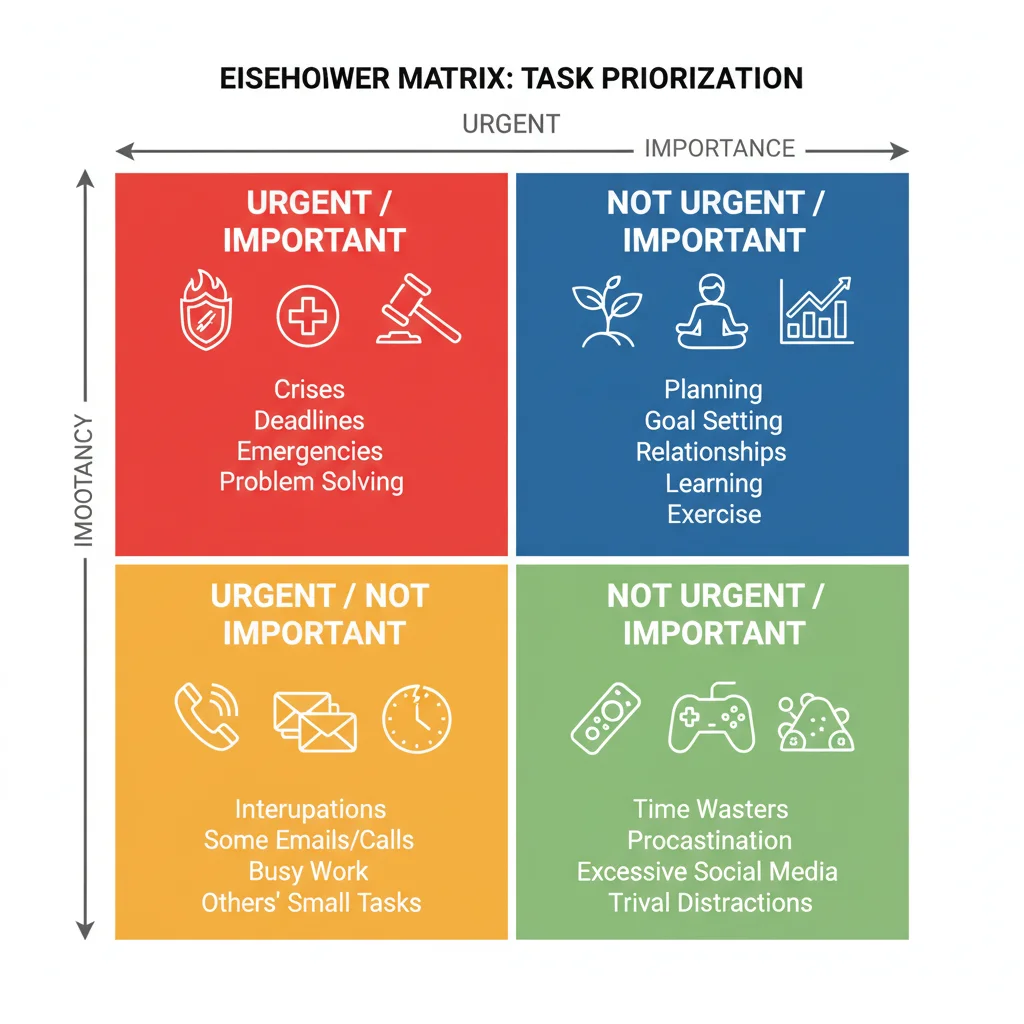
Popularized by Stephen Covey, the Eisenhower Matrix (also known as the Urgent-Important Matrix) is a simple yet incredibly powerful tool for categorizing tasks and making informed decisions about where to allocate your time. It divides tasks into four quadrants:
- Urgent and Important (Do First): These are crises, deadlines, and problems that require immediate attention. Examples: a client emergency, a project due today. Focus on minimizing tasks in this quadrant by proactive planning.
- Not Urgent and Important (Schedule): This is the quadrant of quality, personal growth, and long-term planning. Examples: strategic planning, relationship building, exercise, learning new skills. This is where you should spend most of your time for sustainable success.
- Urgent and Not Important (Delegate): These are tasks that demand immediate attention but don't contribute directly to your core goals. Examples: some emails, interruptions, certain meetings. These are prime candidates for delegation or automation.
- Not Urgent and Not Important (Eliminate): These are time-wasters that provide little to no value. Examples: excessive social media browsing, irrelevant busywork. These should be eliminated entirely.
Regularly reviewing your to-do list through the lens of the Eisenhower Matrix helps you consciously decide where your effort is best spent, allowing you to proactively tackle important tasks and reduce the number of "urgent" crises.
"Eat the Frog": Tackling Your Most Challenging Task First
Mark Twain famously said, "Eat a live frog first thing in the morning and nothing worse will happen to you the rest of the day." Brian Tracy adapted this into a potent productivity principle: identify your most important, most challenging, or most dreaded task (your "frog") and tackle it first thing in the morning.
The benefits of "eating the frog" are manifold:
- Momentum: Completing a significant task early creates a sense of accomplishment and positive momentum that carries through the rest of your day.
- Reduced Procrastination: By getting the hardest task out of the way, you eliminate the mental burden and anxiety that often accompanies procrastination.
- Peak Energy: For most people, morning hours are when cognitive energy is highest. It's the ideal time to focus on complex or demanding work.
- Ensures Completion: Even if the rest of your day goes off track, you've already made significant progress on what matters most.
Combine "Eat the Frog" with your deep work sessions. Identify your "frog" the evening before or first thing in the morning, then dedicate your first deep work block to conquering it. This powerful combination is a cornerstone of effective time management strategies.
Strategy 3: Batching Similar Tasks and Leveraging Automation
Efficiency isn't just about working hard; it's about working smart. Two often-underestimated time management strategies are task batching and automation. These techniques minimize context switching, reduce repetitive strain, and free up significant chunks of your schedule.
Task Batching: The Power of Grouping
Task batching involves grouping similar activities and completing them all at once. The human brain is not designed for constant task switching. Every time you shift from answering emails to writing a report, then back to a quick phone call, your brain has to reorient itself, losing valuable time and energy in the process.
Examples of tasks that are excellent candidates for batching:
- Email and Messaging: Instead of checking emails every 5 minutes, designate 2-3 specific times a day (e.g., 9 AM, 1 PM, 4 PM) solely for processing your inbox.
- Phone Calls: Return all non-urgent phone calls in a dedicated block of time.
- Administrative Tasks: Schedule a specific time each week for invoicing, expense reports, filing, and other administrative duties.
- Content Creation: If you write blog posts, social media updates, or create videos, batch the research, writing, editing, and scheduling processes.
- Meetings: Where possible, schedule internal meetings back-to-back to avoid fragmented work blocks.
By batching, you create "zones" of activity, allowing your brain to stay in a particular mode for longer, enhancing focus and speed. This significantly reduces the mental overhead and context-switching costs, directly contributing to gaining back those 10 hours.
Leveraging Automation: Your Digital Assistant
In 2026, technology offers incredible opportunities to automate repetitive tasks, turning your digital tools into your personal efficiency assistants. Automation is one of the most powerful yet underutilized time management strategies.
Consider automating:
- Email Management: Set up filters and rules to automatically sort incoming emails into folders. Use templates for frequently sent responses.
- Scheduling: Utilize online scheduling tools (e.g., Calendly, Acuity Scheduling) that allow others to book appointments directly into your calendar without back-and-forth emails.
- Social Media Posting: Use scheduling tools (e.g., Buffer, Hootsuite) to plan and post your social media content in advance.
- Data Entry and Reporting: Explore integrations between apps (e.g., Zapier, IFTTT) to automate data transfer between different platforms or generate routine reports.
- Billing and Invoicing: Many accounting software solutions offer automated invoicing, payment reminders, and recurring billing.
- File Organization: Set up automated rules to move downloaded files or email attachments to specific folders.
While setting up automation takes an initial investment of time, the long-term returns are immense. Identify tasks you perform regularly that are repetitive and rule-based. If a task fits this description, there's likely a way to automate at least part of it. The time saved from these small, consistent automations adds up dramatically over a week, contributing significantly to your goal of reclaiming 10 hours.
Strategy 4: The Art of Saying "No" and Setting Boundaries
Perhaps the most challenging, yet most impactful, of all time management strategies is learning to say "no" and establishing clear boundaries. Our time is finite, and every "yes" to one commitment is a "no" to something else – often to our own priorities, well-being, or deep work. In 2026, protecting your time requires assertiveness and clarity.
Understanding the "Opportunity Cost" of "Yes"
Every time you agree to take on an additional task, attend another meeting, or help a colleague with something outside your core responsibilities, you are implicitly choosing that over something else. This "opportunity cost" is often hidden until you feel overwhelmed and realize you have no time left for your own critical work or personal life.
Before saying "yes" to a new request, ask yourself:
- Does this align with my goals and priorities?
- Do I have the capacity to do this well without compromising other important commitments?
- What will I have to sacrifice if I take this on?
- Is this something only I can do, or can it be delegated or declined?
Techniques for Saying "No" Gracefully and Effectively
Saying "no" doesn't mean being unhelpful or uncooperative. It's about being strategic with your time and energy. Here are some ways to decline requests:
- Be Direct but Polite: "Thank you for thinking of me, but I can't take that on right now."
- Explain Briefly (Optional): "My plate is full with existing commitments, so I won't be able to contribute to that project at this time."
- Offer Alternatives or Referrals: "I can't do it, but perhaps [colleague's name] might be a good fit, or I could help you find some resources."
- Propose a Later Date: "I'm fully booked this week, but if you need help next month, let me know."
- Set Conditions: "I can do X, but that means I won't be able to do Y. Which is more important?"
- Don't Over-Apologize: You are not obligated to justify your time.
Setting Clear Boundaries for Your Time
Boundaries are the invisible fences that protect your time and energy. They communicate to others how you expect to be treated and when you are available. Effective time management strategies are impossible without them.
- Communication Hours: Inform colleagues and clients of your preferred communication hours and response times. "I respond to emails between 9-10 AM and 3-4 PM."
- Meeting Protocols: Advocate for shorter, agenda-driven meetings. Decline meetings that lack a clear purpose or that don't require your specific input.
- "Off-Limits" Times: Protect your personal time. Avoid checking work emails or taking calls during family dinner, evenings, or weekends.
- Physical Boundaries: If you work from home, create a dedicated workspace and "close" your office door (mentally or physically) at the end of the workday.
- Vacation: Fully disconnect during vacations. Delegate responsibilities and set an out-of-office message.
Setting boundaries is an act of self-respect and self-preservation. It allows you to create the necessary space for deep work, strategic planning, and personal rejuvenation – all essential components for gaining back 10 hours a week and sustaining high performance without burnout.
Integrating These Strategies for Maximum Impact
While each of these time management strategies is powerful on its own, their true magic unfolds when they are integrated into a cohesive system. Think of them not as isolated tactics, but as interconnected components of a robust personal productivity framework for 2026.
A Typical Week Reimagined
Let's visualize how these strategies can transform your week:
- Morning Ritual: Start your day with a clear plan. Review your Eisenhower Matrix, identify your "frog," and dedicate your first 60-90 minutes to a deep work session focused on conquering that task. No emails, no distractions. (Deep Work, Eat the Frog)
- Mid-Morning: Transition to important, non-urgent tasks. This might be strategic planning, skill development, or working on long-term projects that move your goals forward. (Eisenhower Matrix – Quadrant 2)
- Lunch Break: Take a real break. Step away from your desk, eat mindfully, and recharge. This isn't wasted time; it's an investment in your focus for the afternoon. (Boundaries)
- Afternoon Batching: Dedicate specific blocks for batching similar tasks. Perhaps 30 minutes for emails, 30 minutes for returning calls, and an hour for administrative tasks. (Task Batching)
- Late Afternoon: Address urgent but less important tasks, or engage in collaborative shallow work if necessary. Begin planning for the next day, identifying tomorrow's "frog." (Eisenhower Matrix, Planning)
- End of Day: "Close" your workday. Avoid checking work emails after a certain hour. Protect your evenings for personal life, hobbies, and family. (Boundaries)
- Weekly Review: Set aside 30-60 minutes each week to review your progress, adjust your priorities using the Eisenhower Matrix, and plan the upcoming week. This helps you stay proactive and prevents reactive firefighting. (Prioritization, Planning)
Overcoming Common Obstacles
Adopting new time management strategies isn't always easy. Here are some common challenges and how to overcome them:
- Resistance to Change: Start small. Implement one strategy at a time and build momentum. Don't try to overhaul everything at once.
- Unexpected Interruptions: While you can't eliminate all interruptions, you can minimize them by communicating your deep work times and setting expectations. Learn to politely defer non-urgent requests.
- Feeling Guilty Saying "No": Remind yourself that saying "no" to others is saying "yes" to your own priorities and well-being. It's a necessary skill for sustainable productivity.
- Lack of Discipline: Use accountability partners, set reminders, and reward yourself for sticking to your new habits. Consistency is key.
- Technology Overload: Regularly audit your digital tools. Are they truly serving you, or are they adding to the noise? Simplify and streamline where possible.
The Long-Term Benefits of Effective Time Management
Gaining back 10 hours a week isn't just about getting more work done; it's about creating a more fulfilling and balanced life. The consistent application of these time management strategies will lead to a cascade of positive outcomes:
- Reduced Stress and Burnout: By being proactive and focused, you'll feel less overwhelmed and more in control of your schedule.
- Increased Productivity and Quality: Deep work and strategic prioritization mean you're producing higher quality output in less time.
- Enhanced Work-Life Balance: Reclaiming your time allows you to dedicate more energy to family, friends, hobbies, self-care, and personal development.
- Greater Achievement of Goals: With clearer focus on important tasks, you'll make faster, more consistent progress towards your biggest aspirations.
- Improved Decision-Making: Less reactivity means more thoughtful, strategic choices about where to invest your energy.
- More Opportunities for Growth: The extra time can be used for learning new skills, networking, or exploring new ventures.
As we navigate the complexities of 2026 and beyond, the ability to manage your time effectively will be a distinguishing factor for success and well-being. These four strategies – embracing deep work, ruthless prioritization, task batching and automation, and setting clear boundaries – are not just techniques; they are fundamental shifts in how you approach your day. They are an investment in your future self, empowering you to live more intentionally, achieve more meaningfully, and experience a greater sense of calm and control.
Start today. Pick one strategy, implement it consistently for a week, and observe the difference. Then gradually integrate the others. The journey to reclaiming 10 hours a week is a marathon, not a sprint, but with these proven time management strategies, you are well on your way to a more productive, balanced, and fulfilling life.
Final Thoughts on Your Time Management Journey
Remember, perfecting your time management strategies is an ongoing process of learning, adapting, and refining. There will be days when you fall off track, and that’s perfectly normal. The key is to be consistent with your efforts, reflect on what works and what doesn’t, and continuously seek ways to optimize your approach. Technology will continue to evolve, offering new tools for automation and efficiency, so stay curious and open to incorporating new solutions that align with your workflow. Your ability to master your time is directly linked to your ability to master your life. Embrace these strategies, commit to the process, and watch as you unlock not just more hours in your week, but a richer, more intentional existence.